What’s the article about? This article addresses the fundamentals of welding fixture design and when manufacturers should use custom welding fixtures or modular fixturing to ensure repeatable fabrication.
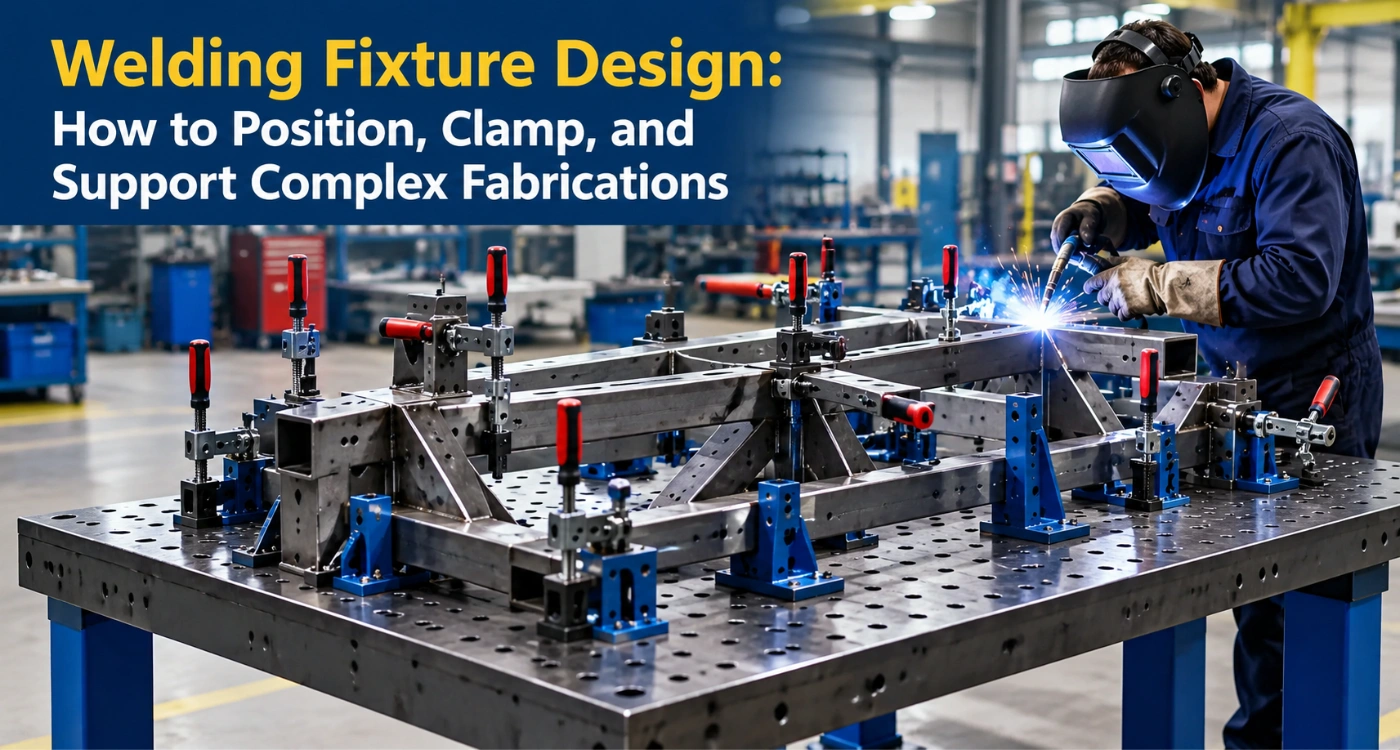
Complex welded assemblies require accurate positioning, controlled movement, and constant support throughout the fabrication procedure. Impactful welding fixture design must help manufacturers to keep components in the correct position, improve repeatability, and maintain surface quality across assemblies. Whether you use modular systems or custom welding fixtures, the fixture should be such that it can accommodate the component’s geometry, welding sequence, production volume, and required tolerances.
What is Welding Fixture Design?
Welding fixture design is how a workpiece will be located, clamped, and supported while welding. A proper fixture should:
- Set accurate reference points
- Prevent unwanted movement
- Support the workpiece without distortion
- Allow access to critical weld joints
- Allow for consistent loading and unloading
It is important that the design balances rigidity and accessibility, so that the fixture supports the process without becoming a problem of a sort.
What Is the Difference Between Locating vs. Clamping?
Honestly, locating and clamping serve different purposes. Locators position the workpiece, while the clamps secure it to the locating points. Here’s a table showing the differences between the two:
| Locating | Clamping |
| It establishes the workpiece position | It secures the workpiece |
| Locating uses pins, stops, and reference surfaces | Clamping uses clamps and holding devices |
| It controls positioning and repeatability | It prevents movement during welding |
| Locating an element is done before clamping | Clamping is done for the locating |
This sequence must be followed precisely in order to design and fabricate reliable welding fixtures.
What is the 3-2-1 Locating Principle?
The 3-2-1 principle is a practical solution to control a workpiece’s six degrees of freedom. In that, three locating points denote the primary plane, two the secondary plane, and one the final reference. The arrangement is suited to the mathematics of the workpiece and the component’s critical dimensions, rather than being robotically applied to every fixture.
How to Stabilise Complex and Irregular Fabrications?
Tubes, frames, brackets, curved parts, and uneven assemblies generally require additional support. Adjustable supports, stops, pins, angles, and fixture table clamps can help to control these components while still allowing access to the welding area. Here, the goal is to keep the workpiece stable at reference points without interfering with welding or inspection.
What About Controlling Movement and Welding Distortion?
Welding heat causes deformation, affecting the final dimensions of an assembly. Proper fixturing can avoid unwanted movement by keeping the component in place throughout the process. However, note that excessive restriction can also cause stress. Welding sequence, heat input, joint configuration, and disturbances should all be considered when designing the fixture.
Should the Weld Area be Accessible All the Time?
A fixture should securely hold the workpiece while providing enough clearance for the welding torch and operator. Poor fixture accessibility can result in repositioning, extended setup times, and inconsistent weld quality. Accessibility should definitely be considered during welding fixture design, rather than post-process.
Fixto is Designed for Repeatability
Fixto’s custom-designed machine fixtures are absolutely ideal for consistent, high-volume production. For prototypes, small batches, or products with frequent design changes, modular fixturing can provide greater flexibility and reusability.
The best approach is determined by component geometry, production volume, accuracy requirements, and expected future changes. A well-designed fixture improves welding control, repeatability, and efficiency, as do Fixto’s modular welding fixtures.
Need credible fixturing for accurate fabrication? Explore Fixto’s custom welding fixtures and modular welding solutions.
FAQs
- How does welding fixture design improve manufacturing accuracy?
An effective welding fixture design controls positioning and movement to achieve optimal assemblies. - When should a manufacturer use custom welding fixtures?
Custom welding fixtures are ideal for manufacturers that produce high-volume or specialised components. - How important is welding fixture design & fabrication?
Accurate locating, secure clamping, adequate support, and weld access are important. - When are customised machine fixtures useful?
Custom-designed machine fixtures are ideal for dedicated production processes and repeat assemblies. - Is it possible to replace custom welding fixtures with modular ones?
Modular systems may be suitable for manufacturers dealing with multiple components or frequent design changes.