What’s the Article About? This article explains how Fixto modular welding tables save long-term fabrication costs compared to traditional custom fixtures. It highlights the benefits of 2D and 3D welding tables in improving efficiency and increasing production flexibility.
In the fabrication scenario, it’s equally important to control production costs and maintain the quality at the same time. While many workshops, big or small, still rely on traditional methods and custom fixtures to improve their work. Over time, this approach becomes expensive, time-consuming, and difficult to scale. This is one of the reasons why so many fabricators have been switching to Fixto’s modular welding table, which is equipped with every possible feature that their workshop needs.
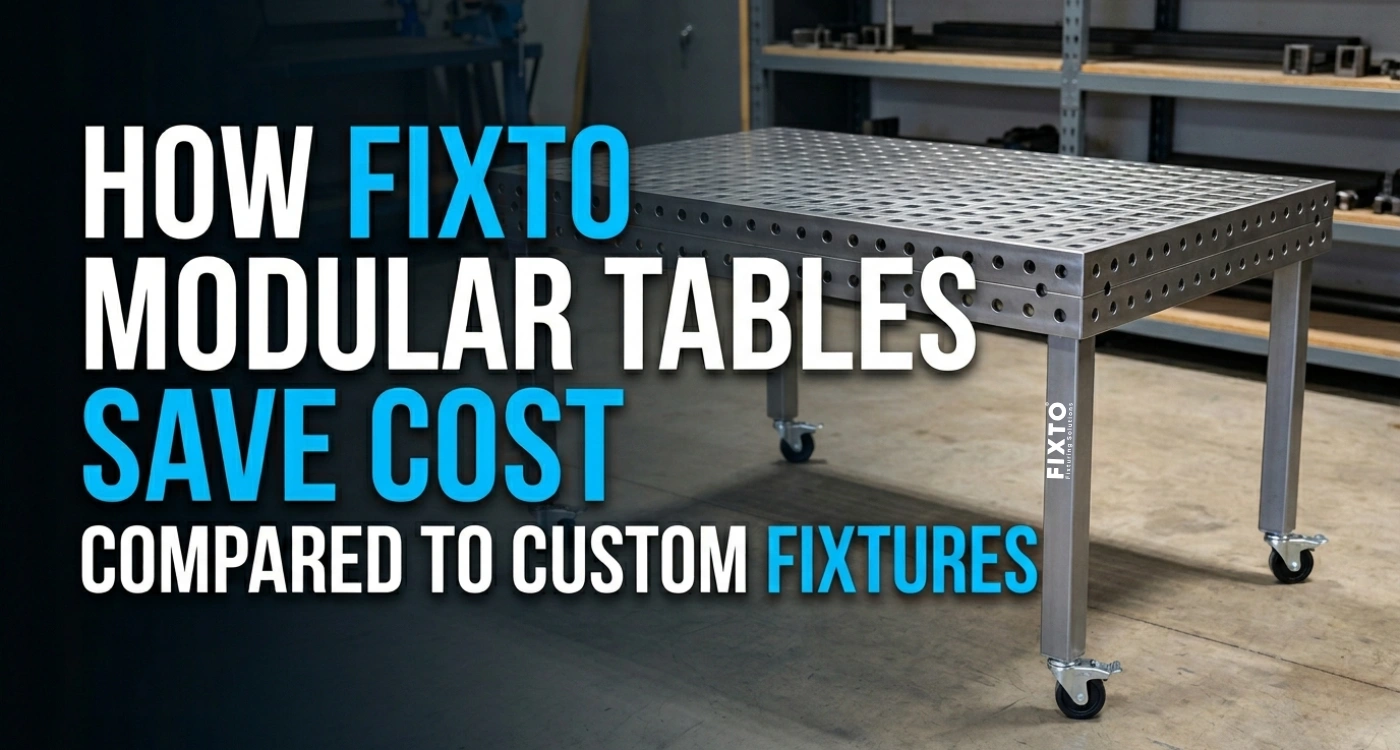
Unlike the customised fixtures, a modular welding table is designed to offer flexibility, repeatability, and reusable fixturing setups for multiple projects. So, whether we are talking about a 2D welding table for flat assemblies or a 3D welding table for complex structures, modular systems are there to help the workshops reduce fabrication costs that they incur in a couple of zeros when they opt for a custom fixture.
How? Let’s see the difference and how you can benefit from Fixto’s modular welding table.
What Are Custom Fixtures, and How Do They Become Expensive Over Time
Custom fixtures are designed to do a singular job for a single piece of work. While they are good enough for repetitive production, such fixtures often create major limitations when workshops handle multiple or custom fabrication projects. Honestly, with custom fixtures, workshops tend to spend on the following:
- New fixtures for a new project
- Material and fabrication costs
- Storage space for extra or unused fixtures
- Repair and maintenance costs
- Set up and alignment adjustments
These costs might seem normal for now, but with time, they add up significantly, only to shock the fabricators with an unexpected dip in budgets.
How Fixto’s Modular Welding Tables Reduce Setup and Labor Costs
If you’ve been in the industry for some time or long, or are just starting, you might or must know that one of the largest expenses in fabrication is labor time. The problem with traditional fixtures is that it required manual measuring, a hundred other components to fix the primary component, and multiple-level alignment checks.
With Fixto’s modular welding table, the whole process is simplified using a precision-based hole pattern and reusable clamping accessories. Fixto’s mechanisms use CNC-machined hole patterns that improve positioning accuracy and repeatability across multiple projects. You’ll see the differences below when you implement it in your routine:
- Faster setup time
- Less operator fatigue
- Reduced fabrication delays
- Improved workflow efficiency
- Lower dependency on repeated measurements
This results in higher daily productivity without increasing workforce costs.
Custom Fixtures vs 2D Welding Table vs 3D Welding Table
Deciding between traditional fixtures and modular systems will become easier when making comparisons of cost-related factors directly:
| Feature | Custom Fixtures | 2D Welding Table | 3D Welding Table |
| Reusability | Limited | High | Very high |
| Set up Time | Slow | Fast | Fastest of all |
| Flexibility | Project-specific | Suitable for flat work | Suitable for multi-angle fabrication |
| Storage Requirement | High | Minimal | Minimal |
| Labor Dependency | High | Moderate | Lower |
| Long-Term Cost Efficiency | Low | High | Very High |
| Scalability | Limited | Moderate | Excellent |
| Repeatability | Moderate | High | Very High |
Through this difference, one thing’s clear: while a 2D welding table is ideal for workshops handling mostly flat fabrication jobs, a 3D welding table provides additional and modernised welding flexibility for multi-angle parts.
Fixto offers both of the options with 16mm hole pattern and 28mm hole pattern, named D16 modular welding table and D28 modular welding table, simultaneously.
Fixto’s Thought: Better Accuracy Means Less Rework and Material Waste
Even a minor fabrication expense is expensive. Misalignment, deformation, or inaccurate fitting can lead to material wastage, rework costs, delayed production timelines, and increased labor hours. With Fixto’s modular welding tables, one can minimize the extra work and problems with a stable and repeatable platform.
Fixto’s welding tables are designed to serve precision and accurate hole-grid systems that support consistency and proper alignment. The nitrided surface helps to keep weld spatter away and improve longevity over time. This further helps workshops to reduce scrap generation, minimize correction work, improve weld consistency, and increase production reliability.
Conclusion: Fixto Is a Smarter Long-Term Investment for Modern Workshops
While custom fixtures may appear to be affordable, their limitations can quickly overpower the craze. A modular welding system is definitely a heavy, long-term investment, but look at the benefits it provides/its adaptability:
- Multiple project types
- New fabrication requirements
- Production scaling
- Workflow optimization
So, even though you choose a 2D welding table for flat fabrication or a 3D welding table for complex assemblies, modular systems help workshops stay productive and competitive. As an experienced welding table manufacturer, Fixto provides modular welding solutions built for precision, durability, and scalable fabrication performance.
Explore Fixto Modular Welding Tables and discover how smarter fixturing can reduce your workshop costs while improving fabrication efficiency.
FAQs
1. How does a modular welding table save fabrication costs?
A modular welding table reduces setup time, minimizes rework, lowers labor dependency, and eliminates the need to build separate fixtures for every project.
2. What is the difference between a custom fixture and a modular welding table?
Custom fixtures are designed for one specific application, while modular welding tables can be reconfigured for multiple fabrication projects using reusable accessories and clamps.
3. Is a 2D welding table suitable for all fabrication work?
A 2D welding table is ideal for flat and standard fabrication jobs. For complex, multi-angle structures, a 3D welding table offers better flexibility and fixturing options.
4. Why do workshops prefer 3D welding tables?
A 3D welding table allows clamping from multiple directions, improves accuracy, speeds up setup, and supports complex fabrication projects more efficiently.
5. Why choose Fixto as a welding table manufacturer?
Fixto offers precision-engineered modular welding tables designed for durability, repeatability, and scalable fabrication workflows, helping workshops improve productivity and reduce long-term operational costs.