What’s the article about? This article explains how shear stress affects ball lock screws and bolts in heavy clamping applications. It covers the load capacity, risks, and best practices for selecting reliable fastening components in welding and fixturing systems.
Even the smallest components provide reliability in the complex industrial applications. Be it welding, fixturing, or any other industrial assembly applications, Fixto’s ball lock bolts have played a crucial role in securing fixtures, clamps, and workpieces while enabling quick setup changes. However, when exposed to heavy clamping pressure, these components have to be strong enough to withstand such forces without falling.
Therefore, understanding what these ball lock screws offer and their shear stress limits is important to maintain safety, accuracy, and long-term performance in the demanding fabrication environments.
What Does Shear Stress Mean in Ball Lock Bolts
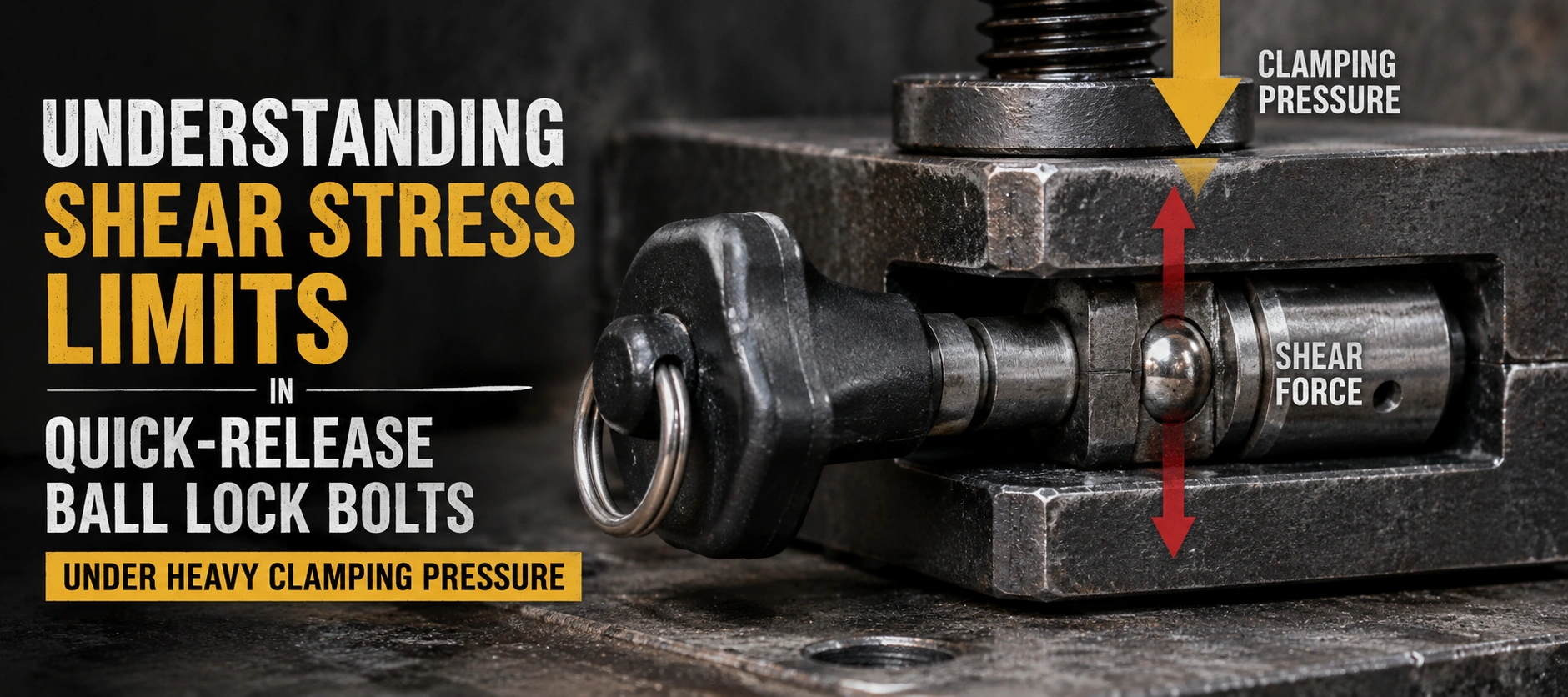
In simple terms, shear stress is a type that occurs when a force acts parallel or tangential to the surface of an object. It further causes the layers of the material or the fluid to slide past one another in opposite directions. In the case of ball lock bolts, shear stress occurs when forces act parallel to a bolt’s cross-section. It attempts to slide one part of the assembly past another. Normally, in the ball lock bolts, shear forces are generated when heavy workpieces, clamps, or fixtures transfer loads through the bolt during operations.
In contrast to the traditional fasteners, ball lock bolts are designed for rapid installation and removal while maintaining a secure connection. The locking mechanism of such bolts uses spring-loaded balls that expand into a mating hole, creating a reliable hold. Although it provides convenience, the bolt itself must withstand the mechanical stresses created by heavy clamping loads. In a few cases, when the shear stress is too much, a bolt may deform, lose alignment accuracy, or fail.
Why Shear Stress Limits Matter in Heavy Clamping Applications
In modular welding and fixturing systems, clamps generate considerable holding force to prevent movement during fabrication. These forces are transferred through the ball lock screw into the fixture setup. Exceeding the recommended limit can lead to:
- Bolt deformation: It will reduce the positioning accuracy.
- Fixture movement: It will result in poor weld quality and misalignment.
- Premature wear: This will increase maintenance costs to a certain level.
- Component failure: It will lead to production delays and safety risks.
For the industries that choose to be staunchly correct at every step and look out for precision and repeatability, just a minor change can affect the quality of the end product. This is the reason why selecting the correct ball lock bolt is critical.
Factors That Influence Shear Stress Capacity
Many factors determine how much shear load a ball lock can handle things safely and securely.
Material Strength
The material used in manufacturing directly influences shear resistance. High-strength alloy steel ball lock bolts generally have a higher load-bearing capacity than the steel alternatives. Reputable ball lock bolt manufacturers maximize longevity and performance by using carefully selected materials and heat-treatment processes.
Bolt Diameter
A larger bolt diameter provides more cross-sectional area to withstand the forces. This is why industrial fixture systems frequently use larger-diameter ball lock bolts for heavy-duty applications.
Clamping Force Distribution
The distribution of force within the fixture setup has a notable effect on the bolt performance. When loads are evenly distributed across multiple fastening points, the stress on individual bolts is reduced, which improves overall system stability.
Dynamic versus Static Loads
Static loads are relatively constant, whereas dynamic loads vary due to vibration, impact, or repeated movement. Dynamic conditions add stress to a ball lock screw, accelerating wear and tear, further reducing its effective load capacity.
What Are The Best Practices for Preventing Shear Failure
To maximize performance and extend service life, manufacturers and fabricators must follow several key practices, including:
Choosing the Right Bolt Size
Try to use a ball lock bolt rated for the foreseen load conditions. Oversizing it slightly for safety can help account for any unexpected stress that arises during operation.
Inspecting Components Frequently
Routine inspections can detect signs of wear, tear, deformation, or damage before failure. It is better to replace worn components early on, which helps to maintain fixture accuracy and operational safety.
Avoiding excessive clamping force
More clamping pressure will not always result in a top-up performance. At times, excessive force can cause stress on bolts, fixtures, and workpieces.
Purchasing from trusted manufacturers
Working with an experienced ball lock bolts manufacturer, like Fixto, will give you access to components that meet industry standards for strength, reliability, and dimensional accuracy.
Final Thoughts: Is Your Ball Lock Bolt Ready For the Shear Stress
Although they appear small, ball lock bolts are extremely important load-bearing components in modern welding systems. Therefore, understanding their shear stress limits will help fabricators to maintain precision, increase safety, and avoid costly equipment failures under high clamping pressure.
In this scene, Fixto is one such reliable ball lock bolt manufacturer who ensures reliable performance in a demanding industrial environment. Selecting the correct ball lockscrew, properly distributing loads, and adhering to recommended operating practices will assist fabricators in growing positively.
Get your high-quality ball lock bolts from Fixto and create stronger, safer, and more dependable fixture systems.
FAQs
- What is a ball lock bolt used for?
A ball lock bolt is used to quickly secure fixtures, clamps, and workpieces in welding, fabrication, and assembly applications.
- How does shear stress affect ball lock bolts?
Shear stress acts parallel to the bolt’s cross-section and can cause failure if the load exceeds the bolt’s capacity.
- What factors determine the shear strength of a ball lock screw?
The main factors include material strength, bolt diameter, heat treatment, and whether the application involves static or dynamic loads.
- Can excessive clamping force damage ball lock bolts?
Yes, applying more clamping pressure than necessary can increase stress on the ball lock bolt, fixture, and workpiece. Overloading can reduce accuracy and lead to bolt failure.
- Why choose Fixto as your ball lock bolt manufacturer?
A reputable ball lock bolt manufacturer provides components made from high-quality materials with proper heat treatment and dimensional accuracy. Fixto ensures consistent performance and longer service life in your demanding industrial applications.