What’s the article about? This article discusses the differences between D16 and D28 welding table hole patterns and why hole size and grid spacing are important considerations when selecting a modular welding table for fabrication.
It is the hole pattern that really makes a difference in how good a modular welding table is. Manufacturers focus a lot on table size, thickness, and load capacity, which is definitely important, but they do not rank above hole pattern. Frankly, the hole diameter and grid spacing decide which accessories you can use, how accurately they can be positioned, and how flexible the fixturing setup will be.
Therefore, for Indian fabricators, it is extremely important to understand the D16 and D28 systems. This will help you select a table suited to your actual production requirements.
What do D16 and D28 Mean?
D16 and D28 are the diameters of the positioning holes in the table. D16 is a 16mm diameter hole, which is commonly arranged on a 50 x 50 mm grid. D28, on the other hand, is a 28mm diameter hole, which is arranged on a 100 x 100 mm grid.
So, if a hole diameter is large, it accommodates more robust locating and clamping accessories, making the system well suited for heavier fabrication, as with the D28 holes. D16 holes have a denser grid, which provides more positioning points for smaller and more detailed assemblies.
Hole Diameter vs Grid Spacing: What Is the Difference?
You learnt about holes, but what are grids, and how do the two differ? Both have different functions. A hole diameter determines the size and compatibility of the pins, clamps, stops, and other accessories that fit into the table. Grid spacing is the centre-to-centre distance between neighbouring holes. A smaller pitch results in more holes across the working surface, allowing for more possible positioning points.
So, the choice between D16 and D28 is more than just hole size. It defines the entire fixturing ecosystem you’ll be working with.
How Does the Grid Pattern Affect Positioning?
A 50mm grid offers positioning with more finesse than a standard 100mm D28 grid. This is especially useful while working with smaller components or assemblies that require closely spaced clamps and locators.
A 100mm D28 grid provides fewer positioning points, but it really works well for larger components where strong workholding and load capacity are more important than fine positioning.
D16 or D28: Which Should You Choose?
Here’s a quick comparison of the D16 and D28 hole patterns to help you decide which best suits your needs:
| D16 | D28 |
| This has 16 mm holes | This has 28 mm holes |
| It typically has a 50 mm grid | D28 typically has a 100 mm grid |
| D16 is meant and used for smaller components | D28 caters to larger components |
| This hole pattern provides precision and finer positioning | D28 hole pattern provides for heavy-duty workholding |
| If you are a small to medium fabrication shop or unit, opt for the D16 pattern | If you deal with heavy industrial fabrication, go for the D28 pattern |
In all, D16 can be useful for small fabrication, sheet-metal assemblies, prototypes, and detailed components that require positioning flexibility. Whereas, for heavy frames, structural fabrication, machinery, and larger assemblies, D28 is usually the better choice.
Why Does the Table Geometry Matter?
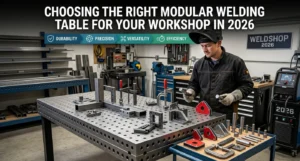
A good modular welding table is a lot more than a flat steel surface. Its hole precision, grid layout, surface flatness, table thickness, and side-hole configuration highly influence how effectively fixtures can be positioned.
Therefore, before choosing a welding table manufacturer like Fixto or any welding table supplier, always consider your typical component size, loading requirements, positioning accuracy, and future needs.
Because the best option is defined by your fabrication needs, not just which system has the largest holes.
FAQs
- What’s the difference between the D16 and D28 welding tables?
Workholding is the use of tools like fixtures, clamps, vises, and chucks to position and secure a workpiece during manufacturing. - What exactly does grid spacing mean on a welding table?
Grid spacing, or the distance between holes, determines the number of available positioning points. - Is D16 or D28 better suited for heavy fabrication?
D28 is normally better suited for larger, heavier fabrication applications. - Can the D16 and D28 accessories be used together?
Generally, no. Each system requires accessories that are compatible with the hole diameter. - How do I select the appropriate welding table system?
Choose based on component size, load requirements, positioning needs, and fabrication type.