What’s the Article Talking About? This article explains how a scissor lift welding table helps improve production efficiency in fabrication setups. It emphasizes the benefits of using a hydraulic welding table to reduce setup time, minimize worker tiredness, improve precision, and ultimately speed up the overall production cycle.
In a small or even a large workshop, many times the delay is not due to the workers but due to the setups. Adjustment of heights, repositioning back and forth, and working around fixed tables is a hassle that cannot be solved in a few minutes. It takes time, but this does not mean that the results can forever be delayed. Over time, such small inefficiencies can turn into big losses. To tame such a situation, Fixto’s scissor lift welding table steps are the saviour of the hour.
Unlike the traditional setups, a hydraulic welding table is designed to improve accessibility, reduce manual effort as much as possible, and orchestrate operations in such a way that streamlines the workforce eventually. To this, add ergonomics, which helps you to curate a solution that directly impacts productivity positively. Although it might be a bit tough at first, let’s break down things to simplify and understand the use of such a modern welding table.
What Is The Actual Problem Behind Delayed Outputs
The production time is wasted in constant bending and repositioning of heavy components, which need to be done once every two hours of work. Add manual lifting and the use of numerous tools to set the height according to the usage. You might know by now the basis of the problems. All this leads to poor accessibility from the fabricator side, which further leads to a slower welding process.
Worker fatigue is a term consistently used in the industry. What does it mean? The above paragraph states the reasons why workers feel tired after just one round of work is completed. Justifiable enough, these things go unnoticed, affecting both the worker and the outcome.
How Does A Scissor Lift Welding Table Help
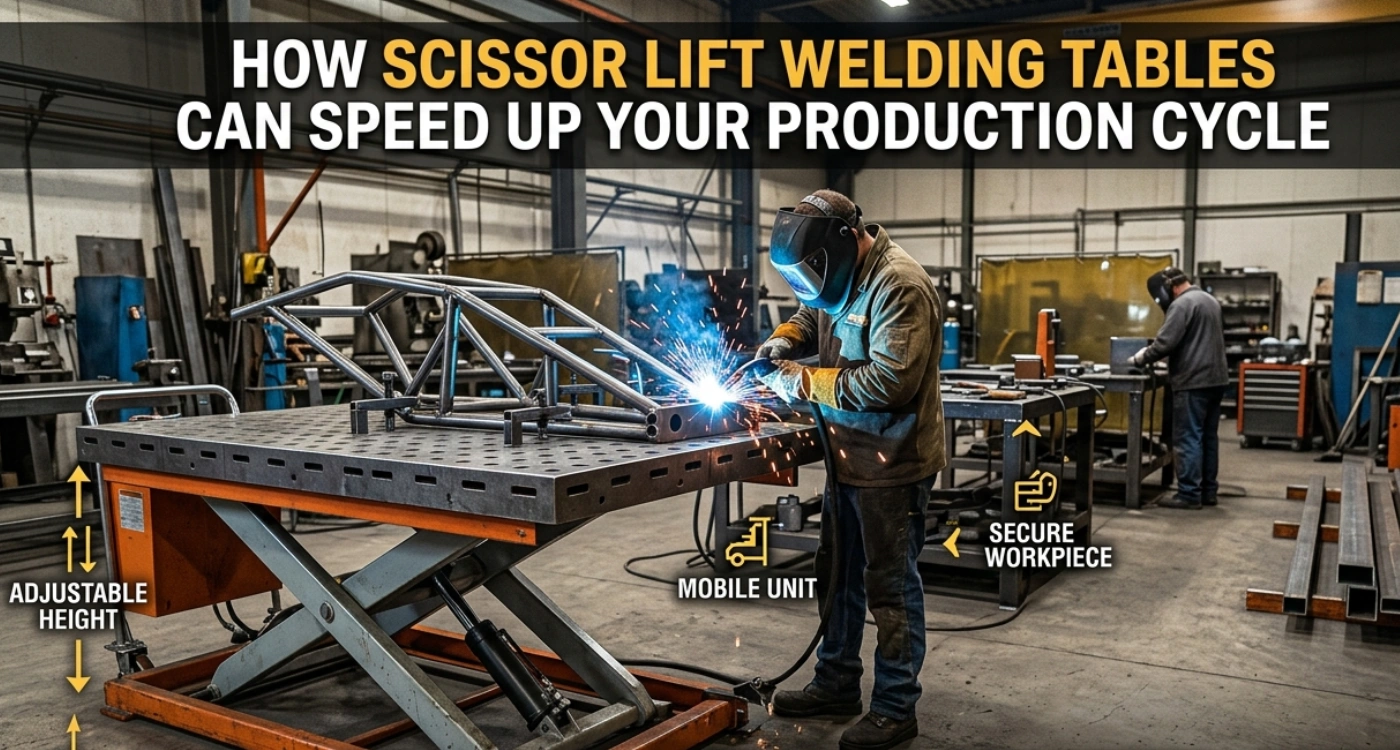
A scissor lift welding table uses a hydraulic mechanism to adjust height smoothly. This is a huge benefit of the system as it helps the fabricators to position the workpiece as they want, meaning totally at their discretion. All this without any manual strain on their shoulders. While the setup times with the conventional methods were longer, with such a welding table, it has become handy, and the work is completed in less time. Hence, faster setup means faster production.
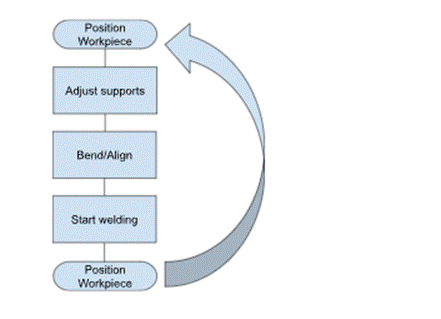
Let’s compare the workflows before and after the use of the hydraulic welding table:
BEFORE SCISSOR LIFT WELDING TABLE
AFTER SCISSOR LIFT WELDING TABLE
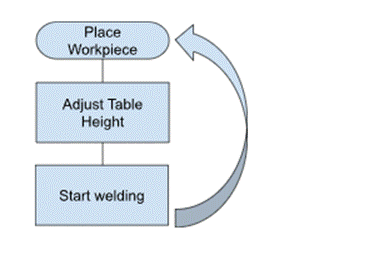
As you can see, the first workflow needs more steps than the second one to finish the work. It is both time-consuming and inconsistent as you have to adjust the support manually, bend or align it as required, and then finally start welding. The second diagram shows a pictorial representation of how quick and efficient the model is.
Improved Precision Means Less Rework
Speed doesn’t mean doing things faster, but it also implies that mistakes need to be avoided at all costs. In the fabrication environment, one single thing can make or break the flow. With a scissor lift welding table, fabricators can position components accurately, improving visibility and control. This results in cleaner welds, less to fewer errors, and reduced rework. This means less rework, more time saved, and faster production cycles.
In workshops where thousands of tasks happen at the same time, a scissor lift welding table allows for quick adjustments for different sizes and types of workpieces. This means no need for multiple fixed tables, faster switching between jobs, and better space utilization. Therefore, it is a smart investment, especially for growing operations.
What’s The Bigger Picture In A Welding Table Scope
An ergonomic welding table doesn’t just improve one step, but enhances the entire workflow. From setup to outcome, each stage becomes faster, smoother, and more efficient. Over the weeks, this all adds up to a higher production capacity, better team performance, and increased profitability. Taking this into the scenario, the overall productivity increases, and therefore, the work is structured, clean, and efficient.
Final Thoughts
If your next achievable goal is to speed up your production cycle without compromising quality, upgrading to a scissor lift welding table is a practical move. It reduces setup time, minimizes fatigue, improves precision, and ultimately boosts output. Merging the same with the benefits of an ergonomic welding table, then you aren’t working harder, but just smarter. In a competitive manufacturing environment, small improvements create big results.
FAQs
1. What is a scissor lift welding table used for?
A scissor lift welding table is used to adjust the working height of metal components during welding as it improves accessibility, diminishes manual effort, and helps speed up the overall process.
2. How does a hydraulic welding table improve productivity?
A hydraulic welding table allows quick height adjustments, lessens setup time, and makes it easier to handle heavy workpieces, improving scalability.
3. Is an ergonomic welding table worth the investment?
Yes, an ergonomic welding table reduces worker fatigue, improves posture, and enhances precision. This results in better productivity and fewer errors over time.
4. Can a scissor lift welding table handle heavy loads?
Most scissor lift welding tables are designed to support heavy-duty applications, making them suitable for industrial use. 5. Does using a welding lift table reduce rework?
Yes, better positioning and improved visibility help welders achieve more accurate results, reducing mistakes and minimizing the need for rework.