What’s the article about?
A 3D welding table minimizes frame warp! It also improves alignment and helps automotive manufacturers achieve tight chassis tolerances. Learn more about it.
Poor fitment of a framework, uneven load distribution, or even alignment issues can create major problems down the production line. Such costly reworks often stem from one common challenge, i.e., frame warp during fabrication. In the automotive industry, where everything relies on precision, maintaining tight tolerances can be non-negotiable. This is where Fixto’s 3D welding table becomes a game-changer.
A 3D modular welding table provides a stable, repeatable, and highly accurate fixturing platform. It also helps manufacturers eliminate crookedness, maintain alignment, and produce chassis assemblies that meet strict quality standards.
But how do these advanced systems help automotive fabricators achieve precision at every stage of production? Let’s see.
How Does a Frame Warp Happen During Chassis Fabrication
Automotive chassis assemblies involve fabricating multiple structural components together, and during welding, intense heat causes metal to expand and contract. So, if components are not properly maintained and secured, this heated movement results in malformation or frame warp. A few common causes of chassis warping include:
- Uneven heat distribution during welding
- Poor component alignment
- Inadequate fixture support
- Inconsistent clamping pressure
- Material movement during cooling
Even minor faults can affect suspension geometry, body alignment, and overall vehicle performance. That’s why manufacturers invest heavily in systems that can make sure that there is dimensional accuracy throughout the process.
How Does a Fixto’s 3D Welding Table Improve Accuracy?
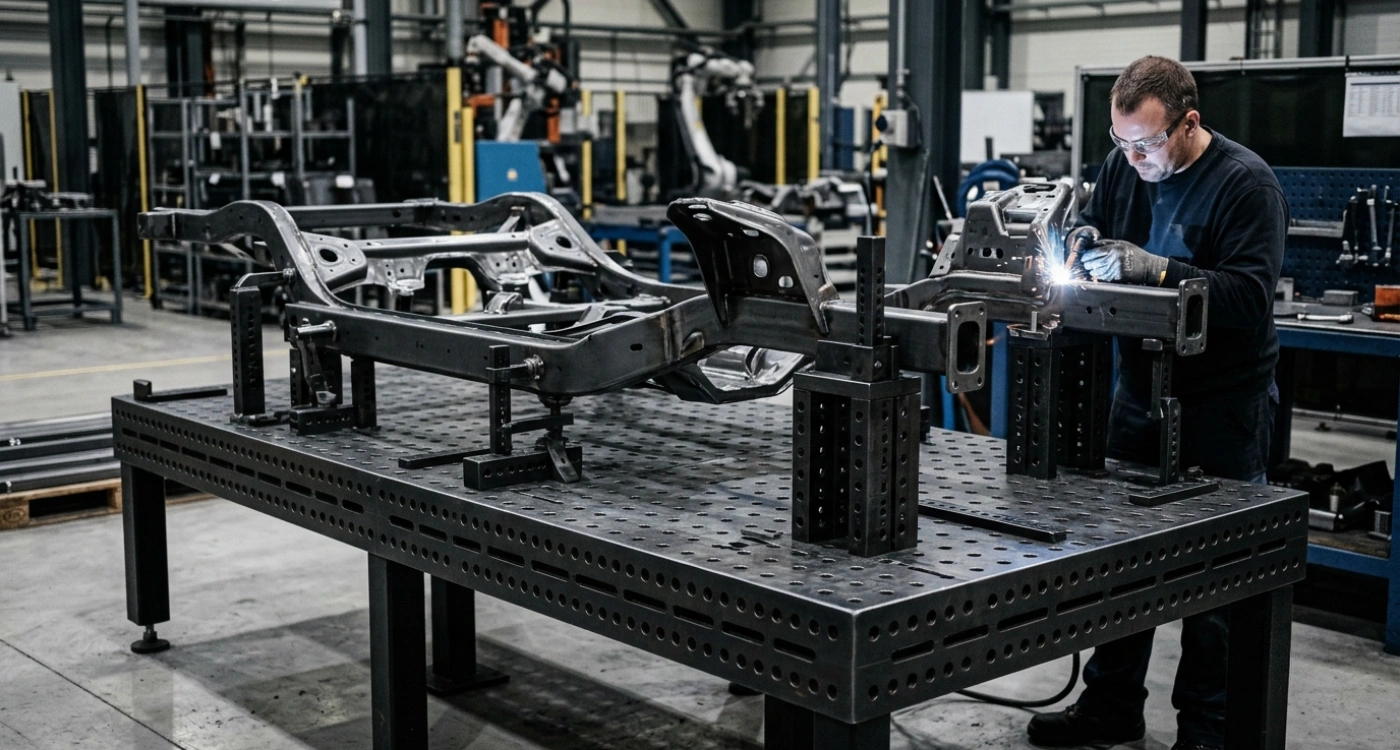
Unlike conventional welding tables, Fixto’s 3D modular welding table is equipped with precise hole patterns and modular fixturing capabilities, which allow fabricators to create highly accurate setups made just for the relative chassis designs. To be thorough with the modular welding table’s role in chassis formation, let’s refer to the table below:
| Feature | Advantages of 3D Welding Table |
| Modular Clamping | The table offers adaptable configurations for various chassis designs. |
| Precise Hole Arrangement | Due to accurate positioning and consistency, the chassis stands no risk of deformation. |
| Numerous Clamping Locations | It aids in minimizing motion during welding. |
| Flat Surface | With enhanced dimensional control, a chassis is consistently produced under supervision. |
| Rapid Adjustment | A 3D modular welding table facilitates quicker production transitions. |
A Modular Welding Table Maintains Tight Tolerances For Better Fixturing
One of the biggest benefits of a 3D welding table is its ability to maintain exactness throughout the assembly process. Even a few slight variations can add up from one assembly to another. Over time, such inconsistencies can lead to increased costs. To aid this, a 3D modular welding table allows operators to do the following:
- Position components in exact locations
- Repeat setups consistently
- Maintain alignment throughout welding
- Reduce measurement errors
- Improve assembly repeatability
The result is a more predictable manufacturing process with fewer defects and less rework.
Welding Tables Ensure Enhanced Stability During Welding Operations
Welding introduces both mechanical and thermal stress into a structure, so if components shift during welding, maintaining dimensional accuracy at that time becomes nearly impossible. The modular clamping systems used with Fixto’s 3D welding table provide secure holding power across multiple points of the assembly. This avoids any unwanted movement, allowing fabricators to distribute clamping force evenly.
Supports Modern Automotive Manufacturing
Today’s automobile sector demands both flexibility and precision. Manufacturers frequently create many car models on the same assembly line. A 3D modular welding table addresses this demand by allowing for quick fixturing. Operators can modify setups to accommodate different chassis designs without the need for totally new tooling systems. This kind of adaptability has numerous advantages, including faster production changeovers, lower tooling costs, increased manufacturing efficiency, more scalability for new vehicle programs, and a higher return on investment.
This is one of the reasons why many of the world’s leading automakers work closely with an experienced 3D welding table manufacturer when upgrading their fabrication equipment.
Conclusion
Although frame warp is still one of the most frequent problems in the construction of automobile chassis, it may be successfully managed with the correct tools. One-size-fits-all, a 3D welding table provides the stability, precision, and repeatability required to keep tight tolerances throughout the assembly process. Precision-driven fabrication processes will continue to be crucial for producing reliable and superior products as automotive standards change.
So, if you, too, are looking to invest in a precision-engineered 3D modular welding table and build chassis assemblies with confidence, visit Fixto for your ultimate 3D welding table manufacturer solutions.
FAQs
- What is a 3D welding table used for?
A 3D welding table is used for positioning, clamping, and securing components during welding and fabrication. It helps improve the overall workflow efficiency. - How does a 3D modular welding table reduce frame warp?
The welding table provides a secure and stable platform for the components during the welding process. This helps to minimize the movement due to heat expansion and contraction, thereby contributing to the reduction of undesirable bends. - Why are tight tolerances important in automotive chassis assemblies?
They aid in proper fitting, the overall alignment, and the structural framework. They also lead to rework reduction and cost minimization. - Can a 3D welding table be reconfigured for different chassis designs?
Yes, the modular design allows users to reposition fixtures, clamps, and accessories quickly to accommodate different assembly requirements. - What should I look for in a 3D welding table manufacturer?
Always look for a manufacturer that offers precision-engineered tables, durable construction, modular compatibility, and reliable support for industrial fabrication applications.