What’s the article about? With this guide, you will know how modular welding tables help automotive manufacturers reduce fixture setup, increase manufacturing efficiency, and overcome common welding fixture challenges with flexible solutions.
You might’ve noticed a rapid growth in the Indian automotive sector. Though it is pleasing, manufacturers are under constant pressure to produce more vehicles in less time while maintaining exceptional quality. So, whether it’s OEMs (Original Equipment Manufacturers), Tier-1 suppliers, or component manufacturers, each production line aims to minimise downtime and maximise throughput. In their process, one of the major hurdles these personnel experience is fixture setup, which also contributes to production loss.
While traditional fixtures cannot be modified to suit the specific production requirements, Fixto’s modular welding tables are transforming shop floors by a positive margin. They are designed for flexibility, precision, and repeatability to suit the various production changes. This also helps manufacturers reduce setup time while improving overall automotive manufacturing efficiency.
Why Does Fixture Setup Time Matter?
There are some common welding fixture problems like:
- Time-consuming alignment of fixtures.
- Dedicated fixtures for individual parts.
- High tooling costs for new vehicle programs.
- Inconsistent positioning during repeated setups.
- Longer production changeovers.
In hindsight, every minute in automotive welding solutions spent either adjusting or replacing welding fixtures is the time when the production line actually stops. In such a growing field, where thousands of components are welded daily, such delays impact output a lot.
How Do Modular Welding Tables Increase Automotive Manufacturing Efficiency?
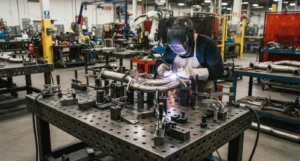
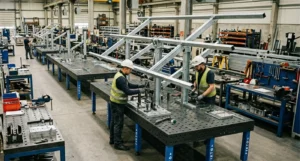
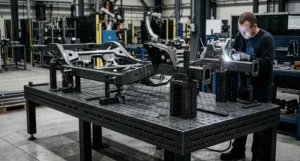
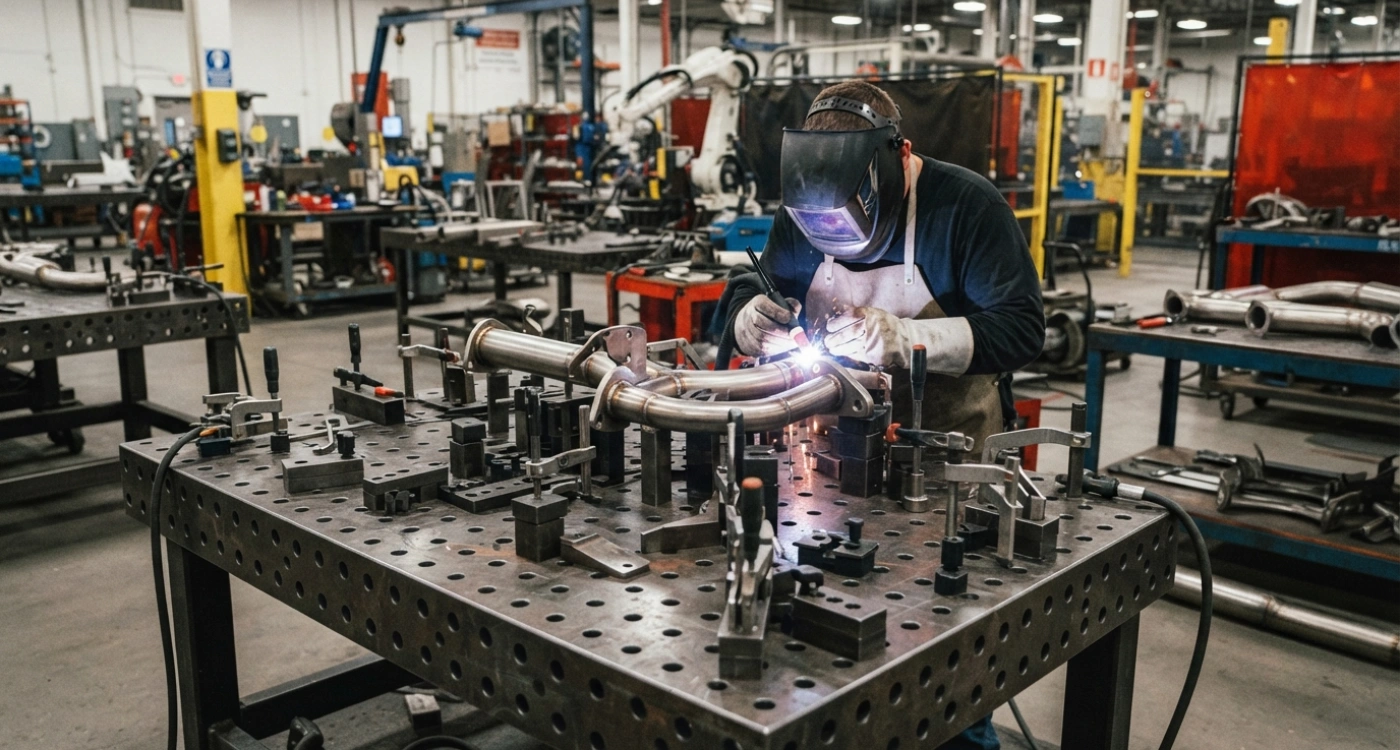
Well, first of all, modular welding tables aren’t like the traditional tables that could only fit one thing at a time. They are diverse, catering to every need that arises in ongoing production. Modular tables use a standardised hole pattern that allows clamps, locators, stops, and accessories to be repositioned quickly for different workpieces. So, instead of fabricating an entirely new fixture for every component, operators are able to reconfigure the same table to accommodate multiple automotive parts with minimal effort.
The flexibility that a modular setup provides is ideal for those manufacturers who handle chassis components, BIW (Body-in-White) assemblies, exhaust systems, suspension parts, automotive sub-assemblies, and prototype and low-volume production. The result is faster setup without a compromise on positioning accuracy.
What are the Key Benefits of Modular Welding Tables
A modular welding table is such a phenomenon in the world of automotive welding solutions that it has the following benefits:
1. Modular Table Enables Faster Changeovers
It is no wonder that automotive production lines frequently switch between different vehicle models and component variants. While traditional fixtures require lengthy adjustments and replacements, which delay operations, components of a modular welding table can be repositioned within minutes using standardised mounting points.
This means faster fixture change, which results in higher machine utilisation and reduced production downtime.
2. Modular Welding Table Improves Positioning Accuracy
When we talk about welding, it all comes down to accuracy. Even a minor positioning error causes dimensional inaccuracies, rework, and scrap. Fixto’s modular tables provide repeatable positioning through precision-machined hole patterns and compatible locating accessories.
This makes sure that every part is held securely throughout the welding process, delivering maximum output.
3. Modular Tables Have Lower Tooling Costs
Manufacturers invest a lot in new tooling for every project as the dedicated fixtures become obsolete over time. Modular systems eliminate these expenses by allowing the same platform to support multiple fixture configurations.
Existing clamps and locating elements are used again, which cuts costs and delivers more throughput.
4. Modular Tables Provide Greater Production Flexibility
The Indian automotive industry serves both national and international export markets. This required frequent product changes and shorter production runtimes. A modular welding table supports this flexibility by allowing quick fixture reconfiguration without even disrupting production schedules.
So, be it an EV platform or the modification of an existing assembly, manufacturers will adapt faster than you can even think.
How to Choose a Modular Welding Table Manufacturer?
Before selecting a reliable partner, look for the following points carefully while evaluating a perfect automotive welding solution for your business:
- High-precision machining for repeatable positioning.
- Compatibility with a wide range of clamps and accessories.
- Heavy-duty construction for industrial use.
- Easy fixture reconfiguration.
- Long service life with minimal maintenance.
Honestly, all these qualities of a modular fixturing system depend heavily upon design and precision. Welding table manufacturers like Fixto understand the very concept of automotive production and deliver systems that are built for accuracy, durability, and scalability.
Concluding Statement
To gain a maximum yield, partner with a dependable modular welding table manufacturer, like Fixto, who is well-versed in what its clients require. You need to have a production line that is ready for changing market demands. For long-term productivity, reduced downtime, and a stronger return on your precious investment, you now know where to come and consult..
FAQs
- What type of welding is commonly used in the automobile industry?
MIG (Metal Inert Gas) welding is the most widely used process. Along with MIG, resistance spot welding and robotic arc welding are preferred for structural and body components. - What are the most common defects in welding?
The most common defects a manufacturer experiences are weld spatter, cracks, porosity, lack of fusion, incomplete penetration, and thermal distortion. - What is meant by manufacturing efficiency?
The term manufacturing efficiency refers to producing more with fewer resources. Further, through continuous process improvements (Kaizen) and waste reduction, this is possible. - What is an ideal size for a welding table?
Although it depends on the application, modular tables typically range from 1200 × 800 mm to 3000 × 1500 mm for the majority of industrial use. - What is the price of a Fixto welding table?
The price varies based on the table size, series, and accessories. Connect with Fixto for your customised quote based on your requirements.