What’s the article about? Compare custom welding fixtures and modular welding tables to understand their differences, benefits, and ideal applications for improving production efficiency and weld quality in modern manufacturing.
Efficient fixturing is the foundation of success when it comes to a successful welding operation. Whether it’s automotive components, heavy engineering equipment, agricultural machinery, or a personalised fabricated structure, Fixto’s fixturing system is the one that will produce the result: correct, precise, and overall effective. But it’s often the case that manufacturers keep questioning whether they must invest in custom welding fixtures or modular welding table.
Although both serve the same purpose of securing workpieces, they are designed for different production requirements. Let’s compare the two options and help you find the right solution for your product environment.
What Are Custom Welding Fixtures?
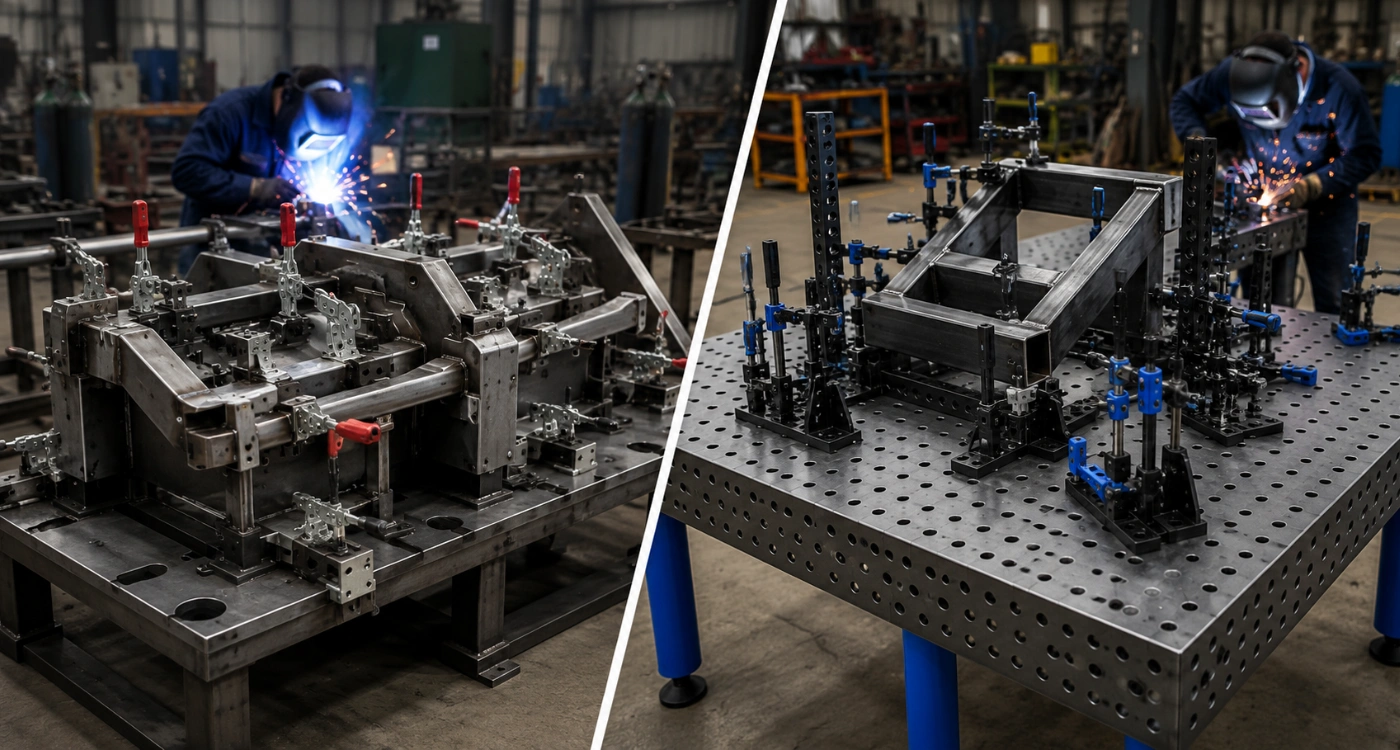
Custom welding fixtures are built for a specific component or assembly. They hold a particular workpiece in a fixed position throughout the welding process. Commonly used in high-volume production where the same part is manufactured, these welding fixtures can be used for a long time.
The benefits of a custom welding fixture include:
- It improves accuracy for repetitive production.
- It supports consistent positioning of identical components.
- After installation, the cycle times are visibly faster.
- Custom fixtures are best suited for dedicated production lines.
Apart from its exceptional benefits, one must also be aware of a custom welding fixture’s limitations. Although highly accurate, they offer very little flexibility. Any design change or new product variant requires modifying an existing fixture or creating a completely new one. This increases tooling costs and lengthens production lead times.
What Are Modular Welding Tables?
A modular welding table is a flexible, precision-driven work system that allows clamps, locators, stops, and accessories to be repositioned quickly. Instead of creating a new fixture each time, as a manufacturer, you just need to configure the same table for as many applications as you like.
Not only does this make a modular welding table valuable, but it also handles product variations and prototype development. Also, don’t forget about the low-to-medium production volumes.
Custom Welding Fixtures vs Modular Welding Tables: A Difference Table
| Basis of Difference | Custom Welding Fixtures | Modular Welding Tables |
| Flexibility | It is designed for a specific component and cannot be easily adapted to new parts. | Modular tables can be easily reconfigured for different workpieces using interchangeable clamps and accessories. |
| Setup Time | Custom fixtures require replacement or significant modification for new product variants, resulting in longer changeovers. | Tables enable quick fixture adjustments, significantly reducing setup and changeover time. |
| Cost | They have higher long-term tooling costs due to dedicated fixtures for each component or project. | Lower overall tooling costs as one table supports multiple fixture configurations. |
| Production Efficiency | Custom welding fixtures are best suited for repetitive, high-volume production of identical parts. | Modular welding tables improve manufacturing efficiency by minimising downtime, reducing idle machine time, and supporting faster production changes. |
Which Option Is Better for Indian Manufacturers?
Since India’s manufacturing sector is evolving rapidly, industries such as automotive, heavy engineering, railways, defence, and industrial equipment produce a wider range of products while also having shorter delivery timelines. Therefore, modular welding tables can provide greater long-term value as they support changing production needs without needing new setups.
However, custom welding fixtures remain the preferred choice for dedicated, high-volume production lines where a single component is manufactured continuously. Some of them adopt a hybrid approach for mass production, so the final choice lies with you.
Conclusion: Why Fixto is the Right Partner For You?
When it comes to custom welding fixtures versus modular welding tables, there is no one-size-fits-all answer. The best option depends on your production volume, product mix, and long-term manufacturing strategy. Fixto, a modular welding table manufacturer, houses a range of custom fixtures and modular welding tables that provide a significant advantage in terms of flexibility, faster changeovers, and lower tooling costs.
As Indian manufacturers adopt lean principles and smarter production practices, modular fixture systems will increase efficiency, maintain weld quality, and adapt to changing market demands.
FAQs
- What is the difference between a custom welding fixture and a modular welding table?
A custom fixture is built for one part, while a modular welding table can be reconfigured for multiple applications. - Which is better for low-volume manufacturing?
Modular welding tables are better because they offer flexibility and faster setup. - Do modular welding tables improve production efficiency?
Yes, they reduce setup time, minimise downtime, and improve workflow efficiency. - Are custom welding fixtures suitable for high-volume production?
Yes, they are ideal for repetitive production of the same component. - How do I choose the right welding fixture for my business?
Choose based on your production volume, product variety, and future manufacturing needs.