What’s the article about? Today’s EV manufacturing requires modular welding fixtures that can maintain dimensional accuracy. Learn why and how modern welding fixture designs are proving useful in the EV industry.
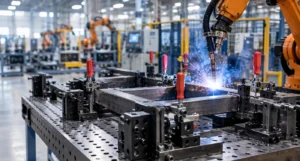
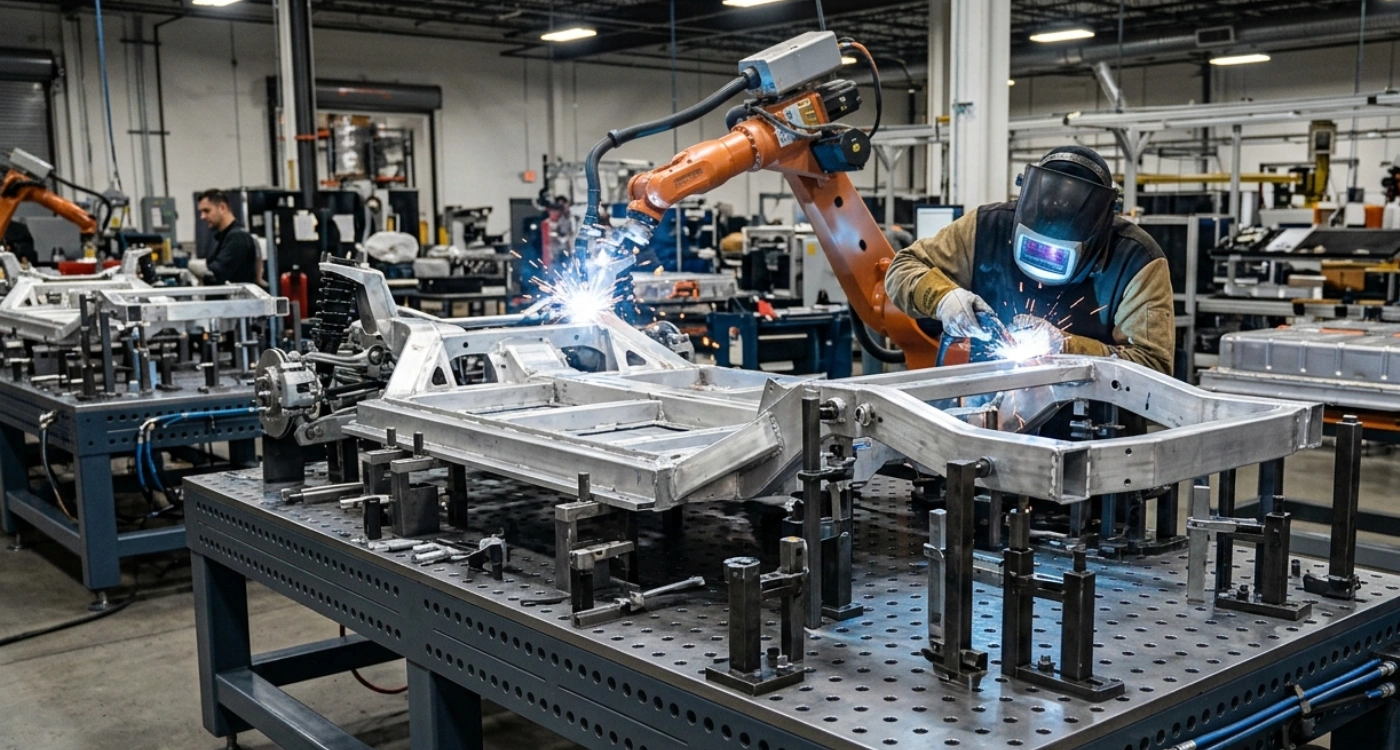
Modular welding fixtures have been expanding the scope of the fabrication industry for quite some time. Finally, we’ve arrived at the long-awaited but unaddressed topic: EV manufacturing. It includes battery trays, aluminum enclosures, structural components, and other parts that necessitate tight dimensional control on the fabrication part as well as flexibility and component variations on the fabricator’s side. This is why industrial welding tables are a common sight at an EV manufacturing unit.
Why Does EV Manufacturing Need Better Welding Fixtures?
The components used in electric vehicles are built using lightweight materials such as aluminium. Therefore, any part made must strictly remain dimensionally stable while also providing structural strength and protection. While previous welding procedures introduced distortion, porosity, and variation, modern fixtures are built differently. They ensure consistent positioning, controlled clamping, and dependable support throughout the welding process.
Not only that, but there are four additional reasons why manufacturers are looking forward to Fixto’s machining guidance in their EV production:
1. Modular Fixtures Are More Flexible
Yes, that is true. Traditional fixtures are only useful when one component is produced repeatedly. With the EV industry booming each day, it is absolutely impossible to use the same variant in batteries, platforms, or other components in each model. EVs require constant change, and modular welding fixtures provide just that.
Moreover, the Fixto welding table also allows clamps, locators, stops, and other accessories to be repositioned for different components without requiring a completely new fixture.
2. Better Control Over Battery Tray Welding
Battery trays need accurate positioning, as the dimensional variation can affect the assembly and sealing operations. Modern EV welding fixtures keep the position of the large aluminium components intact during welding. They also support consistent joint quality and dimensional accuracy of the fabricated component.
For manufacturers, this can mean less adjustment, less rework, and more consistent output.
3. Fixture Design Is Supporting Automation
You might know this better, but EV welding is integrated a lot with robotic and automated production systems. This puts performance pressure on the components to be consistently positioned so that the welding equipment can always access the correct locations.
Modern welding fixture designs are now robot accessible, with repeatable loading, clamping, and unloading. This benefits the fixture as a component of the overall unit rather than a standalone workholding tool.
4. Reconfigurability Is Becoming a Production Advantage
Due to limited time, EV manufacturers and suppliers are forced to move from prototypes to production quickly, while accommodating the changes in the process. A modular welding table with reusable tooling can be configured, modified, and reused for a variety of welding applications.
This approach is already being positioned for use in robotic and cobot welding.
Are Modular Welding Fixtures the One for Indian EV Manufacturers?
Yes, absolutely. For India’s expanding EV manufacturing ecosystem, fixture selection should take into account more than just a mere component. Manufacturers should consider accuracy, rigidity, accessibility, changeover requirements, and potential product variations.
Fixto’s modern EV welding fixtures can help manufacturers create a more adaptable manufacturing setup while maintaining the dimensional consistency required by the components.
FAQs
- What are EV welding fixtures?
EV welding fixtures position and secure components like battery trays, aluminum enclosures, and structural parts used in Electric Vehicle manufacturing.
- Why are modular welding fixtures useful in EV manufacturing?
Because they can be reconfigured to fit with different component designs, further reducing the need for dedicated fixtures as EV models and variants evolve.
- How do battery tray welding fixture designs enhance accuracy?
They enable controlled positioning and clamping, thereby reducing movement, distortion, and dimensional variation during welding.
- Can modular welding tables accommodate robotic welding?
Yes, they can provide uniform positioning and appropriate access for robotic and other similar industrial welding applications.
- What factors should you consider when selecting an industrial welding table?
Always consider how rigid and accurate the table is. Do not forget about the load capacity, clamping methods, accessibility, and reusability.