What’s the article about? Learn how workpiece weight, fabrication type, clamping needs, and usage determine the ideal thickness of a modular welding table.
One of the most important factors to consider while purchasing a modular welding table is its thickness. It not only impacts work accuracy but also the table’s working duration and workplace productivity. In modesty, a table that is too thin can bend under heavy loads, while an unnecessarily thick table can increase costs without delivering any additional value for your application.
So, be it automotive manufacturing, heavy fabrication, machinery production, or precise engineering, understanding how Fixto’s welding table can help you make a smart decision and a good investment is important.
Why Does Welding Table Thickness Matter?
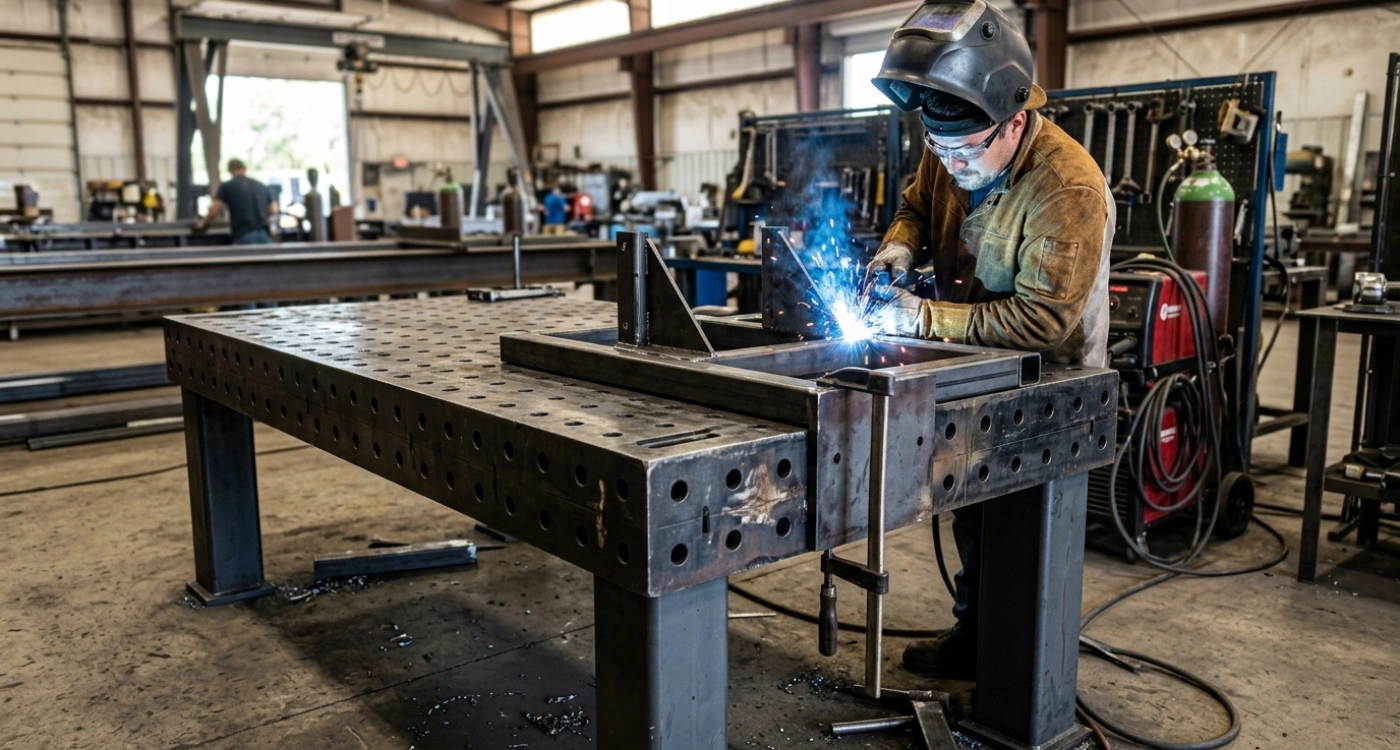
A welding table is the foundation of every fabrication project. It supports the workpiece, withstands heat, and provides a stable surface for clamping and positioning. In case the table lacks the required or sufficient thickness, it can do the following:
- Increase maintenance and replacement costs
- Bend or deform under heavy loads
- Reduce fixture stability
- Affect weld accuracy
For industrial applications where repeatability is the most important factor, choosing the correct thickness ensures harmonious performance for a long time.
What Is the Best Welding Table Thickness?
There is no single thickness that is suitable for all applications. The optimal welding table thickness is determined by your production requirements, workpiece size, and expected load capacity.
As a general guideline:
| Application | Recommended Table Thickness |
| Light Fabrication | 8-10 mm |
| Medium Fabrication | 12-16 mm |
| Heavy-Industrial Fabrication | 20 mm and above |
So, rather than opting for the thickest table, choose a thickness that balances the SPC, i.e., Strength, Precision, and Cost.
What are the Factors to Consider When Choosing Welding Table Thickness?
Since productivity, output, and sanity depend on a welding table thickness, make sure to look for the following factors before making a final decision:
1. Type of Fabrication Work
It is extremely important to define the type of components you manufacture. There are 3 types of fabrication levels, such as:
- Light Fabrication: This includes sheet metal, brackets, and small assemblies that typically require thinner table tops.
- Medium-Duty Fabrication: Agricultural equipment, machine parts, and industrial components benefit from thicker and more rigid tables.
- Heavy Fabrication: This involves structural steel, construction equipment, and large fabricated assemblies that need a robust industrial welding table that is capable of supporting high loads without distortion.
In reality, matching the table thickness with the application will prevent unnecessary wear and tear, while improving welding precision.
2. Workpiece Weight
A welding table must comfortably support the weight of the components that are being fabricated. Heavy workpieces generate higher loads during the process of clamping and welding. But if the tabletop is too thin, it might deflect over time, further affecting the dimensional accuracy and overall welding quality.
Therefore, if you are handling large steel structures or fabricated assemblies, always prioritise rigidity over cost savings.
3. Clamping Requirements
Clamping systems should be precise, and nothing is more important than that in a modern fabrication system. A thicker tabletop provides better support for clamps, stops, and locating accessories. This helps to maintain repeatable positioning throughout the welding process.
This point is important, as a place where accuracy directly influences the final product needs to be fixed beforehand to keep the throughput running.
4. Frequency of Use
Those industrial workshops operating in multiple shifts place greater demands on their equipment. A heavy-duty industrial welding table with a real, appropriately thick tabletop offers good resistance to wear, impact, and heat.
This makes it a great fit for continuous production environments.
Concluding Statement
Identifying the right welding table thickness is critical for maintaining weld quality, increasing productivity, and extending equipment life. The ideal thickness depends on the type of fabrication work, workpiece weight, production volume, and clamping requirements. So, for Indian manufacturers, investing in Fixto’s industrial welding table with the appropriate welding table thickness will ensure greater stability, improved accuracy, and lower long-term maintenance costs.
Are you ready to achieve consistent results and maximize your return on investment by choosing a table that meets both current and future production requirements? Talk to us and take away the best Fixto welding table at the workshop.
FAQs
- What thickness is ideal for a welding table?
The ideal thickness is determined by the workpiece’s weight, fabrication type, and required load capacity. - Do thicker welding tables perform better?
Not always. The ideal thickness strikes a balance between rigidity, accuracy, application requirements, and cost. - What thickness works best for heavy fabrication?
Tables measuring 20 mm or more are typically appropriate for demanding heavy-fabrication applications. - What is an appropriate size for a welding table?
The appropriate size is determined by the dimensions of the workpiece, the available workspace, and the type of fabrication. - What features should I look for in an industrial welding table?
Consider the table’s thickness, rigidity, surface accuracy, hole pattern, load capacity, and fixture compatibility.