What’s the article about? Discover how modular welding tables help solar tracking frame manufacturers improve accuracy, reduce setup time, and scale production efficiently.
It is no wonder that the solar industry is expanding quickly. But so is the demand for solar tracking systems, helping solar panels follow the sun throughout the day, improving energy production. But as demand seems to be increasing, manufacturers are facing a major challenge of producing more tracking frames without sacrificing quality and accuracy.
For years, many manufacturers have used fixed assembly jigs to build solar tracking frames. While these tools work for repetitive jobs, there is one problem with them. When designs change or production needs grow, such jigs fail. That’s why more manufacturers are turning to a modular welding table. But, what is the exact problem, and how does Fixto’s 2D modular welding table prove as a solution to it?
Limitations of Fixed Assembly Jigs
Fixed assembly jigs are designed for one specific product or frame design. They hold parts in place during welding and assembly, helping workers achieve consistent results. However, solar tracking frames don’t really stay the same. Different projects require different sizes or layouts. But when that happens, fixed jigs can create several challenges, including that changeovers take longer, storage space is required for multiple jigs, production becomes less flexible, and costs increase over time.
These limitations can slow down growth for the manufacturers who are trying to scale production.
Why a Modular Welding Table Makes More Sense
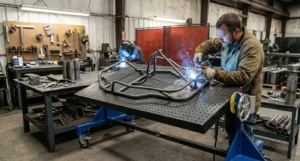
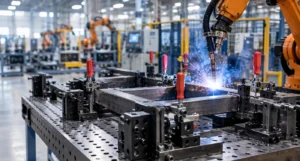
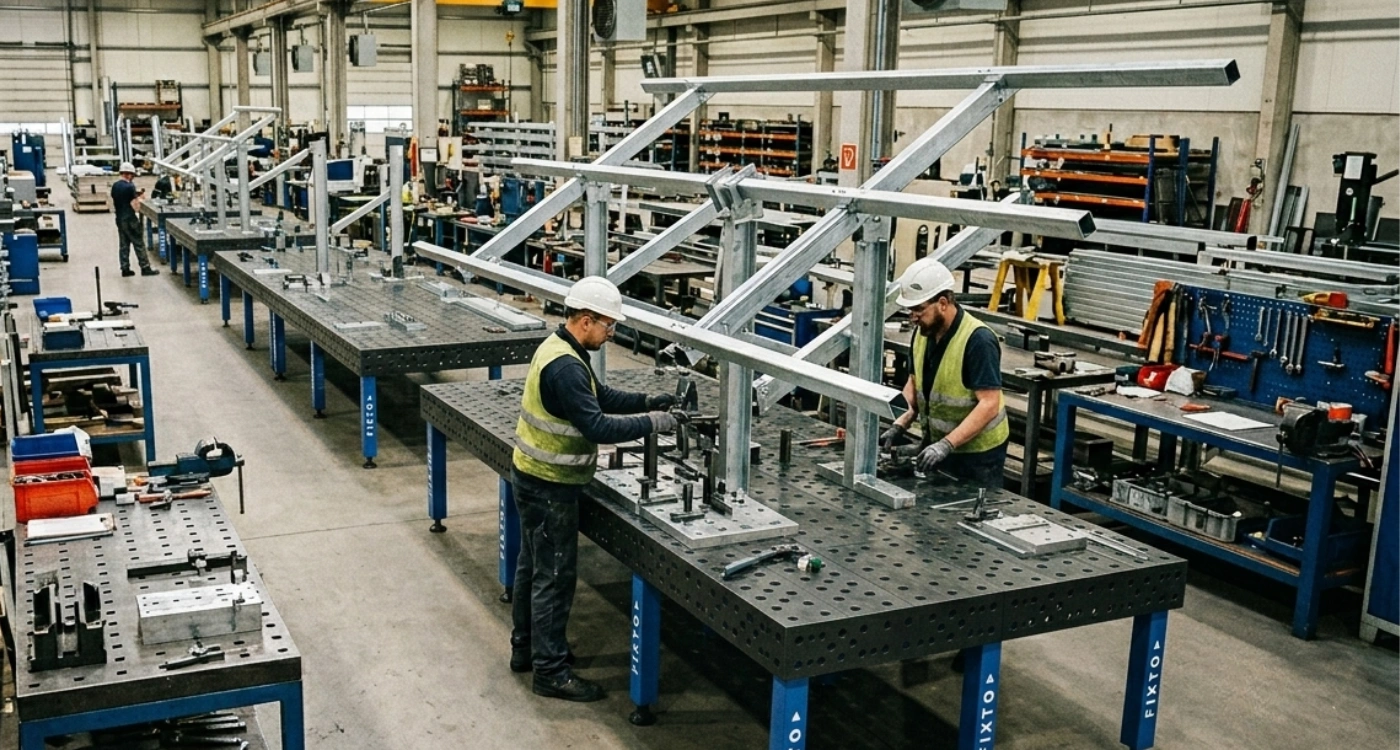
Instead of being fixed to one setup, a 2D modular welding table adapts to different projects. It uses a hole-pattern system that allows clamps, stops, and fixtures to be moved wherever they are needed. For example, if you run a solar company and receive an order for a new tracking frame design, your team can simply reposition the fixtures on the table instead of building a completely new jig.
A 2D modular welding table works especially well for flat-frame assemblies and simple structures. For more complex parts, a 3D modular welding table will provide even greater flexibility.
For Better Accuracy and Consistent Results
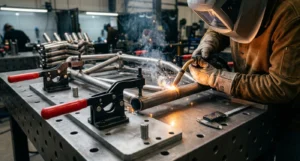
Solar tracking systems rely on accurate alignment. If the frame is even slightly off, it can affect how the panels move and perform once installed. To ease this, a modular welding table solves this problem by providing a stable and accurate work surface.
To help you understand, consider a fixed assembly jig versus a modular table.
| Feature | Fixed Assembly Jig | Modular Welding Table |
| Flexibility | Provides very little flexibility. | A modular table is extremely versatile. |
| Setup Changes | A fixed jig will take longer to set up than expected. | A 2D or 3D welding table’s flexibility allows for faster setup and operation. |
| Accuracy | Good accuracy, but it could be improved. | Remarkable precision-driven results. |
| Adaptability | It has a limited adaptability. | A modular table can be customized to any shape. |
| Long-Term Value | Okay to moderate | One will never regret their investment. |
Because the setup can be repeated easily, manufacturers can produce multiple frames with the same level of accuracy every time.
Faster Production with Less Downtime
In manufacturing, everything depends on time; the longer it takes to switch between jobs, the more productivity is lost. One of the biggest benefits of a 2D modular welding table is its ability to reduce setup times. Fixtures can be moved quickly, allowing workers to start the next project sooner.
On top of that, a 3D modular welding table offers even more flexibility by allowing components to be positioned on different surfaces and angles, further useful for larger or more detailed assemblies. From faster production cycles, less downtime between projects, to better use of labor and equipment, and increased output without increasing complexity, Fixto’s modular tables are one of a kind.
Therefore, for companies looking to grow, these improvements will definitely make a significant difference.
Modular Welding Tables: A Better Solution for Future Growth
As solar energy projects continue to expand, manufacturers need systems that can grow with them. Investing in a new fixed jig every time a design changes simply isn’t practical. A modular welding table will give manufacturers the freedom to adapt to new designs, reduce setup times, and maintain consistent quality across every project.
Whether using a 2D modular welding table or a 3D modular welding table, manufacturers will be directed on a pathway to improve productivity while preparing for future growth.
So, why think more? Upgrade to the modular welding table manufacturer Fixto’s collection and build solar tracking frames faster, smarter, and with greater precision.
FAQs
- What is a modular welding table?
A modular welding table is a work table with a hole-pattern system. It allows clamps and fixtures to be positioned accurately as per the project requirements. - Why are modular welding tables better than fixed assembly jigs?
Modular welding tables are extremely flexible, as they can be molded for different frame designs, while fixed jigs are usually made for only one setup. - What is the difference between a 2D and a 3D modular welding table?
A 2D modular welding table is mainly used for flat assemblies, while a 3D modular welding table allows fixturing on multiple sides and angles for more complex projects. - How does a modular welding table improve production?
It reduces setup time, improves accuracy, and allows faster changeovers between projects, helping manufacturers increase productivity. - Are modular welding tables suitable for solar tracking frame production?
Yes. They provide the flexibility, precision, and repeatability needed to produce solar tracking frames efficiently and consistently.